
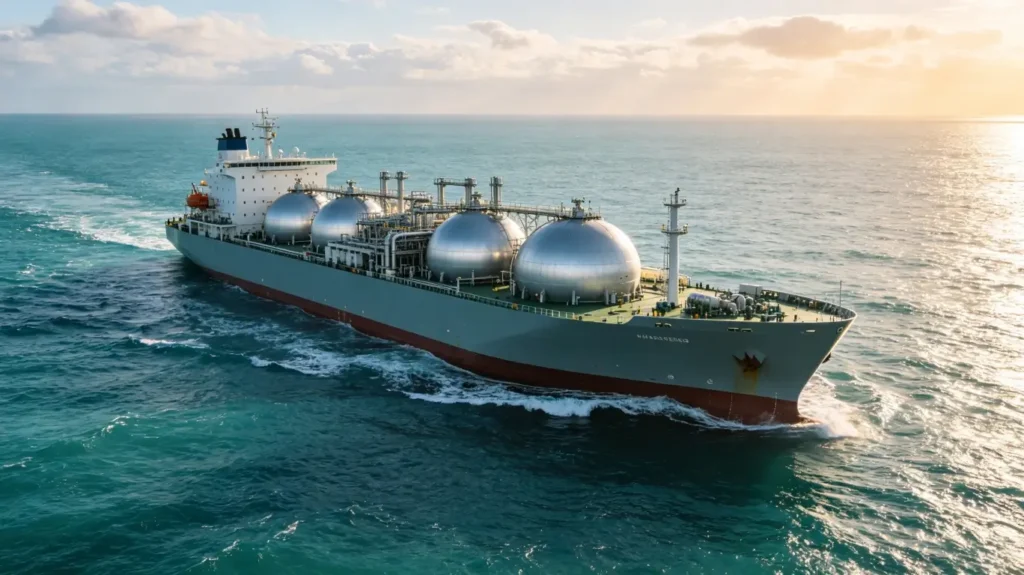
Liquefied Natural Gas (LNG) carriers are specialized vessels designed for transporting LNG at -163°C. Due to their extremely high design and construction complexity, they are hailed as the “jewel on the crown of shipbuilding.” Alongside large cruise ships and aircraft carriers, they are collectively known as the “three crowns of the maritime industry.”.
The sheer size of a large LNG carrier is astonishing. Take the 175,000 cubic meter class vessel as an example: it measures approximately 295 meters in length and 46.4 meters in width, with a deck area equivalent to three standard football fields. A single full-load transport of liquefied natural gas can meet the combined domestic and industrial gas demand for the entire city of Dalian for over a month and a half.
Core Technology and the “Heart” System
The core technology of LNG carriers is the liquid cargo containment system, which must safely store liquefied natural gas at ultra-low temperatures of minus 163°C, akin to the “heart” of the vessel. Globally leading systems can keep evaporation losses to an extremely low level during ocean voyages.
The current mainstream technologies primarily originate from France’s GTT company. The Mark III Flex model has a daily evaporation rate of only 0.085%; the NO96 Super+ ensures a daily evaporation rate of 0.085%. The latest generation GTT NEXT1 combines the advantages of both technologies, achieving an evaporation rate as low as 0.07%. China’s independently developed “BrilliancE® II” system is manufactured with 5083-O aluminum alloy material, offering extremely high safety and reliability, and enabling unrestricted loading.
In terms of propulsion systems, modern large LNG carriers are commonly equipped with LNG dual-fuel low-speed main engines, with both fuel oil and gas modes meeting the International Maritime Organization’s highest emission standards. Taking the “Tianshan” as an example, the adoption of a dual-fuel propulsion system can reduce daily carbon emissions by over 10 tons compared to traditional fuel-driven vessels.
Market Landscape and Chinese Influence
As of February 2026, there were nearly 800 LNG carriers in operation worldwide. French company GTT predicts approximately 550 LNG carriers will be ordered between 2026 and 2035, with Asia accounting for about 80% of the demand growth.
China’s shipbuilding industry has experienced rapid development in this field. In 2025, Hudong-Zhonghua delivered 11 LNG carriers, setting a new industry record. Currently, Hudong-Zhonghua has over 80 vessels on order, with deliveries scheduled until 2030. In July 2026, Dalian Shipbuilding delivered the “Haineng,” a second-generation 175,000-cubic-meter LNG carrier independently designed and developed by the yard. That same month, the second 180,000-cubic-meter ultra-large LNG carrier, “Goa,” was delivered in Nantong, Jiangsu. Global shipyards’ LNG carrier construction capacity is projected to increase from approximately 90 vessels in 2026 to over 100 by 2028, with Chinese and Korean shipyards being the primary drivers of this expansion.
Challenges and Future Trends
The market is under pressure from oversupply. The LNG fleet is set to grow by approximately 10% in 2025 (adding 89 vessels), with planned deliveries of 94 and 92 vessels in 2026 and 2027 respectively. Backlog orders reach 343 vessels, equivalent to 42% of the current fleet.
The decline in charter rates is accelerating the scrapping of older vessels— the average age of LNG carriers being scrapped has dropped from 38 years to 25 years. Over 260 LNG carriers (accounting for approximately 35% of the total) are more than 15 years old.
Meanwhile, technological innovations continue to break through: BW LNG pioneered the new triple-hold ship design, increasing cargo capacity to 177,000 cubic meters; China’s Jiangnan Shipyard introduced the world’s first 192,000 cubic meter Type-B tank electric propulsion LNG carrier design; and the LNG bunker vessel fleet is expected to grow by over 60% within three years.
LNG carriers are continuously evolving toward larger cargo capacities, lower evaporation rates, and greater environmental sustainability, playing an indispensable role in the global energy transition.